Showing posts with label Froulala Travel. Show all posts

6.17.2011

Southern Treasures


A few months ago, Maricris Encarnacion, my Where at Cebu editrix who wears many interesting hats, gave me this assignment for the May-July 2011 issue. It's been a long time since I've visited a few of Cebu's notable heritage churches. No doubt, I am looking forward to revisit while I'm in town. Amazing photography by Erwin T. Lim, one of the top photographers in the country.


"Cebu is the earliest European settlement established in 1565 by Spanish conqueror, Miguel Lopez de Legazpi, making it the oldest city of the Philippines. The city counts its beautiful old stone churches in the South part of its historical treasure trove. Albeit overlooked and somewhat languishing in different states of disrepair, they fiercely remain woven into the fabric of people’s lives. Royal Spanish ordinances from 1573 specified that the principal church should be visible from all sides and be above ground level in order to “acquire more authority”.  The Church was the largest property owner in colonial cities so urban space was planned around it." --- M. Te, Where at Cebu
"Let’s start 40 kilometers south of the city, Carcar, named after a town in northern Spain. Here sits the second oldest church of Cebu, St. Catherine of Alexandria Church. Built in 1858, it took 16 years and three friars to finally finish it. The minaret shaped twin bell towers of solid geometric pylons act as buttresses but are integrated as part of the simple façade. Embellishments are limited to the geometric flora on the spandrels, the blind rose window below the upper recessed arch and the carved Augustinian symbol above it. It is noticeable that all the twelve apostles were carved in white except for Judas, who was done in black. Fr. Manuel Rubio Fernandez who was instrumental in finishing the church construction executed the refined touches. It would be ideal to have a tasting of Carcar’s famous chicharon (pork rinds), ampao (rice crispies), and bucarillo (caramelized coconut strips) before moving on." --- M. Te, Where at Cebu
"The architectural style leans toward Spanish or Mexican Baroque. The first master builders and artisans mainly came from Mexico where the Spanish colonization started. Special conditions of the country were considered:  typhoons and earthquakes, tropical weather, termite attacks, and human invasion. This led to the christening of Philippine church architectural style, “Earthquake Baroque”. Furthermore, integration of Chinese and Muslim forms and style elements are visible. The technique of air-dried red brick made from a mixture of coral lime and/or loam and sugar cane juice was learned from the Chinese. Moorish elements or Mudejar style are evident in grills and balustrades, bas-relief carvings, and minaret like bell towers." --- M. Te, Where at Cebu
"The municipality of Argao, 26 kilometers south of Carcar, is named after the sali-argaw trees that grew in the area. St. Michael the Archangel Church was constructed in 1734-1788. Valuable artifacts, the original altar, figures of angels sculpted on its brass-studded portals still remain. The 5-storey belfry, considered one of the best in the Philippines, was constructed in 1830. It has 8 bells, 5 of which are still in good condition, a clock, and an organ built locally by Spanish or Mexican organ builders. It is one of the remaining fourteen pipe organs and one of the 3 in Cebu built between the Spanish Baroque (17th  century) to Neo Gothic (19th century) periods. The now unplayable instrument has wind chests and channels constructed from a big piece of narra wood. Religious murals on the ceiling were executed by two of the best church muralists, Canuto Avila and Reynaldo Francia, during the early 20th century. The simple rectangular façade is divided into three levels and segments with the use of Corinthian columns and horizontal cornices surrounding its beautifully arched entrance. Before leaving Argao, make sure you take torta to go for the car ride. They are known for the dense cakes made with egg yolks, pork lard, sugar, flour, and leavened by fermented coconut." --- M. Te, Where at Cebu

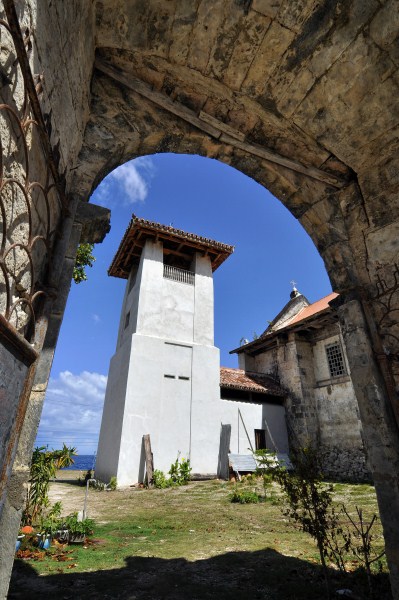
"The oldest stone church of Cebu is in Boljoon, Church of Patrocinio de Maria, and 37 kilometers south of Argao. Founded in 1599, a fire in 1782 decimated the first structure that had a gorgeous painted ceiling. The town is in a picturesque cove on a sliver of land between the sea and rocky hills. With topography prone to Muslim attacks, a blockhouse or dakung balay was constructed along with the church. It is a sizeable quadrangular fortress made of meter thick coral stonewalls and tile roofs. Artillery equipment and a telegraphic system were installed in the fortress for protective measure. Today the blockhouse serves as the bell tower."--- M. Te, Where at Cebu

"An organ installed in 1880 at the choir loft still remains. Intricate carvings and bas-relief adorn the interiors. A communion rail with ornate silverwork was stolen from the church. Its square belfry built in 1701 still exists today without its silver bells. Stolen during a raid and never recovered when the Muslim vinta (vessel) allegedly sunk because of their weight. The Boljoon Church portrays the best sense of the Philippine colonial past truly making it a cultural treasure. It was declared a National Historical Landmark in 1999." --- M. Te, Where at Cebu

"Often, we travel far away to marvel at the conspicuous but there is much to appreciate from off-the-beaten-path journeys. Cebu’s historic churches are a repository of our rich heritage and culture. One can add a historical bent on a Visita Iglesia during Semana Santa and get extra mana credit. Filipinos are a superstitious lot and strongly believe that a wish made during the first visit to a church is always granted. Armed with a healthy dose of wishful thinking and Proustian wisdom along the way, ---“the real voyage of discovery consists not in seeking new landscapes but in having new eyes”; a heritage hopscotch to the South is strongly urged." --- M. Te, Where At Cebu


6.16.2011

Skylines

Despite being semi-packed days ago, it took me awhile to decide what to leave behind yesterday. Its incredulous to have separation anxiety with my desk. I wanted to pack my reading pile too hoping that I'll finish them all this summer. When I realized that I would have to give up non negotiable accessory space in my suitcase, that idea quickly went out the window. Suddenly, the thought of a Kindle appealed to me for the first time but I'm still old school when it comes to holding a book in my hand and dog-earring pages.
The lunar eclipse also did a surprise number on me. I couldn't find my camera and a jewel box with precious contents which really got me all worked up.
I'm fervently hoping that the blue crocodile box will surface sometime soon.
It was hard to leave Charlotte not knowing where it is but the warm send off and profusion of tight hugs consoled me some.

My NYC layover was harried as I ran around to get a couple of things and dropped by Tenpenny for a quick meal before heading to JFK. Recently reviewed by Sam Sifton of the New York Times, the tables on my row all came after reading it.
We compared notes and each bite packed a lovely flavorful punch. The couple who sat next to me went twice within 4 days.
Perhaps it was Tenpenny's signature cocktail unforgettably called, The Unstrung Harp, with a chaser of prosecco, I was ready to melt into my seat by the time I boarded.
7 hours later, I woke refreshed after days of mad rushing.
Cathay Pacific's entertainment selection has always been topnotch. Normally so restless,  I can only do movie marathons on long haul flights.
 film 1: An Education - a coming-of-age film I've been wanting to see 
film 2: Love and Other Impossible Pursuits - heartwarming family drama
film 3: Incendies - a brusque and riveting tale about war and family
read the Sagittarius chapter on Susan Miller The Year Ahead 2011
Finally used up all my 15 hours and landed in Hong Kong, 
my favorite airport. 
very user friendly and great duty free shopping
showered, bought a Father's Day present, lounged
3 hours later, I boarded for my 2.5 hr flight to Cebu
I remember an exchange with my dear friend, Cornel Chiriac, 
while we were on the way to 
Santiago de Compostela last Sept 20, 2007.
Buckled up on Ryan Air's sardine seats,  he said, 
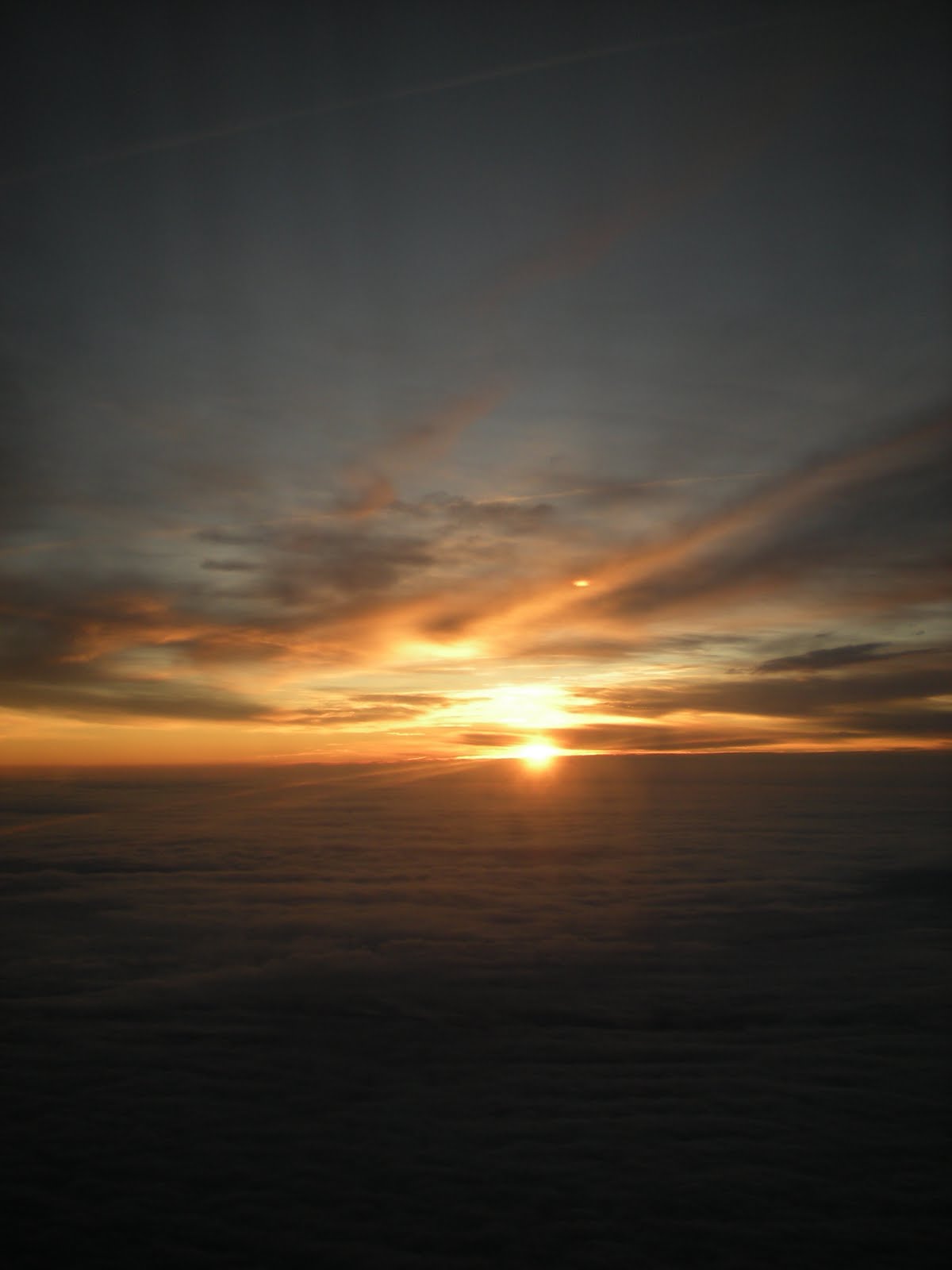
this is my favorite part as the plane ascended to meet the sunrise 
and Frankfurt-Hahn grew small beneath us.
I, on the other hand, have always loved the landings, 
the speed rush before the grounding halt. 
Just how I would run to a loved one and stop at a hug.
 Plane to plane. City to city 
Just like the first time.
flight soundtrack: So Far Out to Sea and Barefoot
The latest album, Giants by Chicane, has its signature ambient hits and some cheesy trance. Still love it tho and brings back memories of wild abandon in many sunny shores and seeing them live in Manila.

*photos are from personal archives*

6.12.2011

Colors of Summer

I've spent most of the week packing for the summer season and wrapping up work since I'm off to Cebu to work on some SNUG products in between spending time with loved ones. It seems like all I do is chase time. Either I don't manage time well enough or it feels like there's just never enough time to do ALL the things I want to do. Last Saturday---friend and brilliant photographer, Steve Cook, came by and captured my Saturday morning. He caught all my packing mess among a few other things. It seems futile but I do keep trying to pack light. I've already sent a 300 lb box ahead full of gifts and just-in-case sartorial combos and I'm now onto my 2 1/2 suitcases that are almost my size. I may be small but I have Napoleonic tendencies when it comes to juju-jewels and packing. All the photos are by Steve except for my official Frou La La summer 2011 tableaus.


6.05.2011

Vizcaya Museum and Gardens

I took a break from laying out and cocktailing this weekend and looked through some sunny photos and saw these from my archives. I frequently visit South Florida to see my aunt and uncle. The last time I did, good friend Carmen Natschke of The Decorating Diva fame, strongly urged a visit to Vizcaya Museum & Gardens.
I'm so glad I took the drive to Miami from West Palm Beach, 
it was such a treat.

James Deering, 1916
 "Vizcaya was home to James Deering and a large staff that managed the estate. Deering occupied Vizcaya only in the winter months, from 1916–1925, when he died. Deering was a Vice President of the International Harvester Company, which produced agricultural equipment for a worldwide market.  He chose a bayfront site in Miami for his tropical winter home because of the location’s temperate winter climate and his appreciation of the native hardwood hammock.  In addition, his father, William, had already settled in Coconut Grove and his half brother, Charles Deering , would soon develop an estate at Cutler, in what is now south Miami-Dade County. The latter is now operated as The Deering Estate at Cutler. " --- vizcayamuseum.org
 
 Architect Burrall Hoffman, 1912
I'm including photos from Women's Wear Daily at a recent third annual Vizcaya Preservation Luncheon where they say, big hats and head-to-toe black prints were the reigning trends.


 entrance loggia
"At the time of Vizcaya’s construction, Miami’s population was around 10,000.  More than 1,000 workers were employed in the Vizcaya project, including laborers and craftsmen from the Caribbean and Europe.  In addition to the house and gardens, the complex included a farm, livestock, and a variety of other service facilities covering 180 acres on both sides of South Miami Avenue." --- vizcayamuseum.org

Secret Garden workers, 1916

the secret garden

 Village in 1917


entrance hall
"When he began building his winter home, Deering engaged the assistance of Paul Chalfin , a young New York painter, to supervise the entire project.  Deering and Chalfin traveled throughout Europe surveying residential architecture for ideas and obtaining components such as doors, wall panels, mantels and ceilings that would be incorporated into the proposed home. Also working on the project were architect F. Burrall Hoffman and Colombian landscape architect Diego Suarez . " --- vizcayamuseum.org
painter Paul Chalfin


"The house was intended to appear as an Italian estate that had stood for 400 years and had been occupied and renovated by several generations of a family.  It has 34 decorated rooms with 15th through 19th century antique furnishings and art objects. The house appears to be only two stories high but between the main public rooms and the bedrooms, there is an intervening level with 12 rooms for servants and service. Vizcaya intends to open these rooms to the public in the near future, thereby introducing new stories about those who lived and worked at the house." --- vizcayamuseum.org
James Deering's library
banquet hall
music room
the cathay
Deering's sitting room
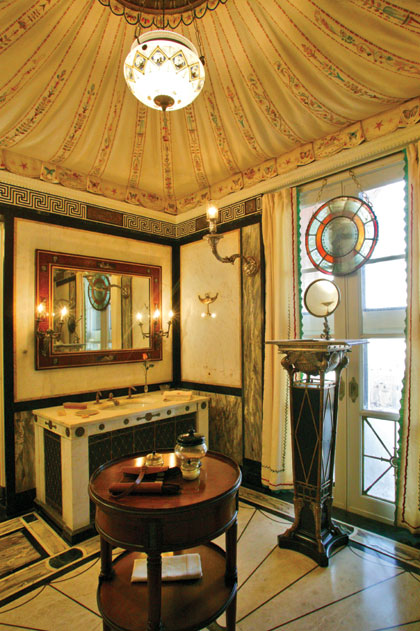
Deering's bathroom
I was particularly taken with his shaving stand positioned in such a way that he would have a water view while shaving in the morning.
I took this photo of the other side of the bathroom.
James Deering's bedroom
 
guest bedroom
reception room
breakfast room
Perhaps it was the afternoon light streaming in, the breakfast room glowed. I loved the eclectic explorer flavor of the room with chinois touches.


flower-arranging room


The kitchen was a favorite of mine as well. Handsome hanging copper pots and pans always attract me and the immense hardware of this oven is gorgeous.
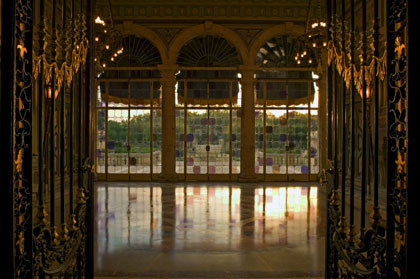
 east loggia
the tea room

embossed ceilings and walls leading up to the tower
also featured in one of the guest rooms

another desired area was the hallway 
that contained a smattering of one of a kind pieces
here's my adorable nephew, Zar
staircase photo from the museum archives


detail shot of stone barge from the museum archives

gazebo


view of the villa from the gazebo


 Vizcaya aerial photo
"The expansive gardens combine elements of Renaissance Italian and French designs.  Suarez and Chalfin worked for seven years, perfecting the design of the gardens as one vast outdoor room with the elements serving as complementary parts of an integrated area. Key features include the many fountains, a central pool surrounding an elevated island, the elevated Mound with its small house, or “Casino,” statuary, and several themed gardens." --- vizcayamuseum.org
landscape architect Diego Suarez, 1969


marine garden
 south terrace to the mound
 maze garden
David A. Klein orchidarium


After Deering’s death in 1925, a minimal staff maintained the house.  The hurricane of 1926, which devastated much of Miami, extensively damaged the house, surrounding grounds and formal gardens. Deering's heirs, Marion Deering McCormick and Barbara Deering Danielson, contacted the estate's original designer, Paul Chalfin, who oversaw the first restoration of Vizcaya in 1933-4. The McCormicks and Danielsons attempted to operate the estate as an attraction, but another major hurricane in 1935 overwhelmed their efforts. Eventually most of the land was sold for development. In 1952, Deering’s heirs generously conveyed the main house and formal gardens to Dade County, for a sum below the actual value.   In 1955, The County exercised an option to acquire the village as well.  Deering's heirs donated the estate's substantial furnishings and art to the County on condition that Vizcaya be used as a public museum in perpetuity. Over the years the effects of South Florida’s elements have taken their toll on Vizcaya, making constant restoration and the installation of a climate control system a necessity."  --- vizcayamuseum.org

We ended the day at the charming
Casa Tua restaurant.
It houses a members-only club and 5-suite boutique hotel 
personalized and designed by Michele Bonan.


The cozy feel of the restaurant goes with its 
well executed rustic menu.
grilled octopus

ravilolini del plin with sauteed mix mushrooms,
truffle pecorino, and black truffles

*photos are from personal archives (taken December 2009)except for most of the historical professional images and the fashion photos are from WWD*